Comparing die casting in Taiwan vs China comes down to three things that differ by country: the trade framework your parts arrive under, the legal protection available to your design, and how much of your supply chain sits in one place. Casting capability itself varies far more between individual foundries than between the two countries.
In July 2026 one US duty regime expired and a replacement took effect the following morning. The Section 301 tariffs announced by USTR on 23 July 2026 came into force at 12:01am the next day and cover 60 economies responsible for 99.4% of US imports.
What follows compares the two countries on the points that can be checked rather than assumed, drawing on our own experience of aluminum die casting production in Changhua, Taiwan since 1987.
How do tariffs differ for castings from Taiwan and China?
As of July 2026, Taiwan trades with the United States under a bilateral Agreement on Reciprocal Trade concluded in February 2026, while Chinese goods carry duties accumulated across several separate actions layered on top of one another. One relationship has a negotiated structure. The other remains an open dispute with further investigations still running.
What the July 2026 action changed
The action taken by the Office of the US Trade Representative addresses the failure of the covered economies to enforce prohibitions on goods produced with forced labor. Rates were set at 10 percent for economies that have adopted or committed to a forced labor import prohibition, and 12.5 percent for those that have not. Taiwan falls into the more favorable treatment alongside the European Union, Japan, Korea, and Switzerland.
Rates change, and they have changed repeatedly through 2025 and 2026. The interval between announcement and entry into force in this case was under 24 hours.
Why aluminum castings may sit outside the headline
Aluminum castings may be excluded from the July action altogether. USTR’s fact sheet states that “all articles and parts of articles subject to section 232 tariffs” are not covered, and aluminum and its derivative products fall under Section 232.
This cuts both ways. Moving production out of China does not remove duty exposure on aluminum parts either, because Section 232 applies by product classification and metal content rather than by country alone. Whether a specific part falls inside that scope depends on its HTS code, which makes it a question for a licensed customs broker rather than for a foundry.
What predictability is actually worth
Duty rates are only part of the cost of a shifting trade policy. Forecasting, repricing, contracts reopened, and decisions deferred while the numbers are uncertain all carry a cost of their own, and none of it appears in a piece price comparison.
A supplier in a country with a negotiated trade framework offers a more stable basis for planning. Across a three or four year program, that stability can outweigh a marginal difference in unit cost.
Origin documentation and transshipment
Country of origin determines duty treatment, so the documentation supporting it matters. Routing Chinese castings through a third country and relabeling them creates a liability rather than a saving.
When casting, machining, and finishing happen at the same company in the same country, the paperwork supporting your customs entry is simpler to assemble and easier to defend. Ask any prospective foundry what origin documentation they will supply, and note how quickly they answer.
How is your design protected in each country?
Taiwan operates a specialist Intellectual Property and Commercial Court, with rights administered through the Taiwan Intellectual Property Office. For a foreign OEM this means a defined forum, an established process, and a realistic route to enforcement if one is ever needed. That is a structural difference between the two countries, and it can be verified independently rather than taken on trust.
Who owns the tooling
Ask a supplier who owns the mold. The answer, and how readily it comes, tells you a great deal.
At JoinCast, you own your mold once it has been paid for. It stays secured within our facility with access limited to the production teams assigned to your parts, and ownership does not change if you decide to move your program elsewhere. Get ownership, custody, and transfer rights recorded in the contract before any tooling money changes hands, whichever supplier you use.
Safeguards that apply in either country
Legal frameworks matter, but practice matters as much. Insist on non-disclosure agreements enforceable in a court that would realistically hear your case. Control who receives your drawings and at what stage. Require dedicated cavities rather than shared tooling. Release design data progressively rather than sending a complete package to a supplier you have not yet qualified.
At JoinCast, NDAs are standard in our contracts and we do not produce similar parts for competitors without explicit customer permission. Our relationships with Fortune 500 clients rest on that basis.
What actually determines die casting quality?
Casting quality is determined by process control, mold engineering, and inspection discipline rather than by country of origin. Individual foundries within either country vary more than the two countries do.
The variables that matter
Mold engineering and gating design determine whether a part fills properly before a single shot is fired. Die temperature and shot control determine consistency from the first part to the fifty thousandth. In-process inspection determines whether a drifting process gets caught in the cell or discovered at your dock. Porosity control and pressure tightness verification determine whether a housing holds.
Alloy selection sets limits too. Anodizing appearance, heat treatment options, and corrosion performance are all constrained by the alloy before tooling is cut, which we cover in detail in our guide to die casting alloy names across regions and the companion article on choosing the right aluminum alloy.
The documentation to ask for
None of this is visible on a quotation. Fortunately it is visible in documentation, which a capable foundry should be able to produce on request.
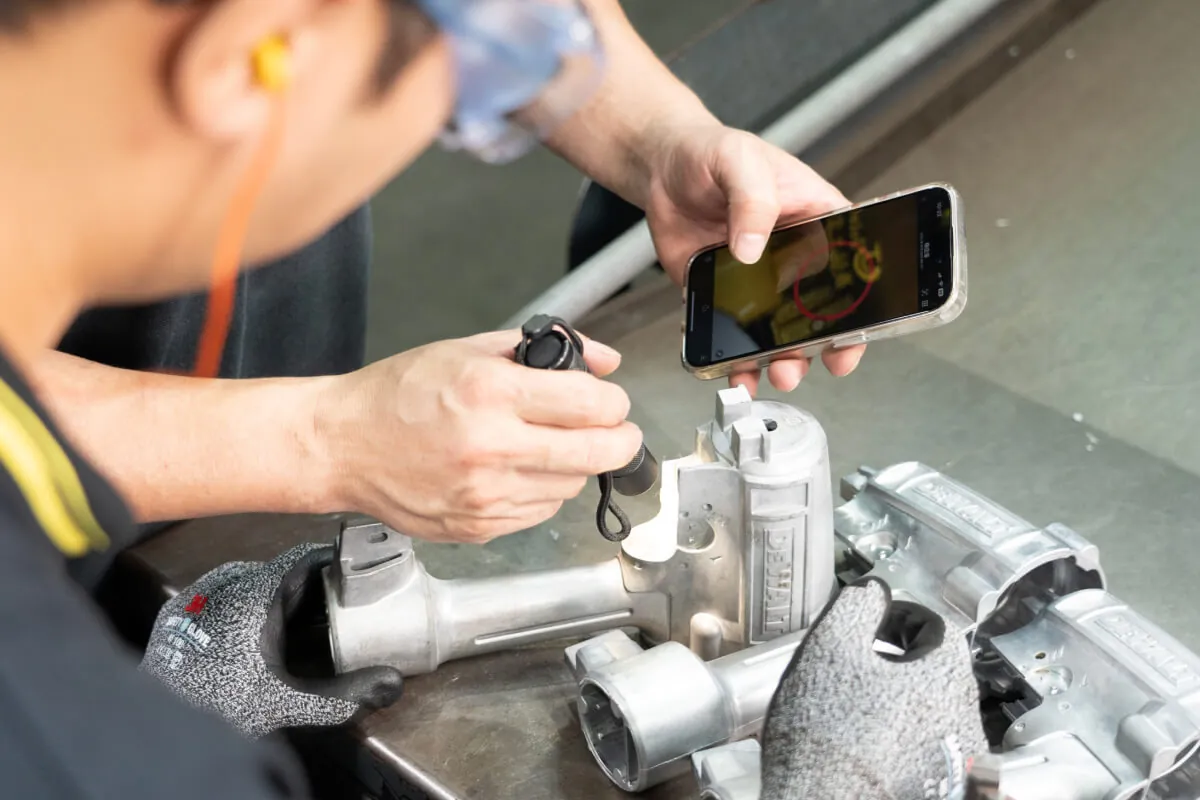
Ask for first article inspection reports from a comparable part, material certifications, and dimensional reports. Ask how batches are traced from alloy to shipped component. Ask what inspection equipment sits on the floor and how many people are dedicated to quality rather than production.
For reference, JoinCast holds ISO 9001:2015 certification and runs a ten person quality team using two Mitutoyo CMM systems, Keyence 3D scanning, material spectrometry, salt spray testing, and surface roughness verification. Documentation comes as part of the process rather than as a special request, and we have written separately about how real-time monitoring supports batch accuracy.
Engineering support before tooling is cut
Alloy and process decisions tend to be made better with the foundry than before approaching one. A drawing review before tooling is cut identifies what will cast well, what will not, and what needs changing while changes are still cheap.
We provide design for manufacturability feedback with every quotation, typically within five to seven working days, together with recommended process flow and tooling costs. We cast ADC-12 / A383, which accounts for around 82% of our production, and ADC-3 / A360 where corrosion resistance governs. Our sales, engineering, and quality teams work in English, Japanese, and Chinese, and as a foreign-owned supplier based in Taiwan, bridging a Western drawing and an Asian foundry is routine work for us.
Comparing total landed cost
Piece price is one component of what a casting program costs over its life. Tooling cost and tooling life, minimum order quantities and the working capital they tie up, freight and duty and brokerage, scrap and rework, and the management time spent coordinating separate suppliers all sit outside the number being compared.
| Taiwan | China | |
|---|---|---|
| US trade framework (July 2026) | Bilateral Agreement on Reciprocal Trade, February 2026 | Layered measures from separate actions, further investigations open |
| Section 232 aluminum exposure | Applies by product and metal content | Applies by product and metal content |
| IP enforcement route | Single specialist Intellectual Property and Commercial Court | Specialist IP courts in major cities, provincial courts elsewhere |
| Typical strength | Moderate volumes, tight tolerances, demanding finishes | Very high volume, lowest piece price |
| Weaker fit | Commodity parts where piece price dominates | Programs carrying substantial design IP |
When casting, CNC machining, polishing, surface treatment, and insert molding happen under one roof, a layer of coordination between separate suppliers disappears. That coordination rarely appears as a line on a quotation, though it tends to show up in the schedule.
When China is the better choice
There are cases where China remains the right answer, and we would rather say so than pretend otherwise.
Very high volume commodity castings where piece price dominates and the design carries little intellectual property play to China’s scale. Parts destined for the Chinese domestic market follow the same logic. And where an established supplier is performing well, the cost and disruption of switching may not be justified by anything in this article.
Taiwan tends to make more sense where design protection matters, where volumes are moderate rather than enormous, where tolerances and finish requirements are demanding, and where a stable trade relationship has value to your planning.
Where JoinCast fits
JoinCast has been casting aluminum in Changhua, Taiwan since 1987. Across three production sites totaling 9,900 m², our team of 170 runs 12 die casting machines from 135T to 900T with an annual capacity of 2,000 tons, supplying customers in 55 countries across North America, Europe, and Japan.
Mold engineering, die casting, CNC machining to ±0.015mm, surface treatment, TPR insert molding, and quality inspection all happen in house. If you are weighing this decision, send us a drawing and we will tell you what we would recommend, including the cases where we are not the right supplier for the part.
Frequently asked questions
Is die casting in Taiwan more expensive than China?
On piece price alone, often yes. Across a full program the gap narrows once tooling life, scrap rates, coordination between separate suppliers, and the cost of recalculating duties each time policy shifts are included. Compare programs over their expected life rather than comparing two quotations side by side.
Does sourcing from Taiwan avoid US tariffs?
No. Section 232 measures on aluminum and aluminum derivative products apply by product classification and metal content rather than by country alone, so an aluminum casting from Taiwan still needs reviewing against its HTS code. Taiwan’s bilateral trade framework helps with predictability rather than exemption. Confirm your own classification with a licensed customs broker.
Do the July 2026 forced labor tariffs apply to aluminum castings?
Generally no. USTR’s fact sheet for the action, effective 24 July 2026, states that all articles and parts of articles subject to Section 232 tariffs are not covered. Aluminum and its derivatives fall under Section 232, so castings may be unaffected by that action while remaining subject to existing aluminum duties.
Who owns the mold if I move my parts to a different foundry?
At JoinCast, the customer owns the mold once it has been paid for. It remains secured in our facility during production with restricted access, and ownership transfers with the program if you move it. Any foundry should be willing to put this in writing, and reluctance to do so is worth noticing.
How do I protect my design when sending drawings to an overseas foundry?
Use an NDA enforceable in a jurisdiction that would realistically hear the case, release design data in stages, require dedicated cavities, and get written confirmation that your supplier will not produce similar parts for competitors. Taiwan’s specialist Intellectual Property and Commercial Court provides a defined route to enforcement if it is ever needed.
Can a Taiwanese foundry handle high volume production?
Yes. JoinCast runs 12 machines from 135T to 900T across three sites with 2,000 tons of annual capacity and 24 hour production capability, supplying programs that exceed 500,000 units per year. Kanban and JIT delivery are available where your schedule requires them.